
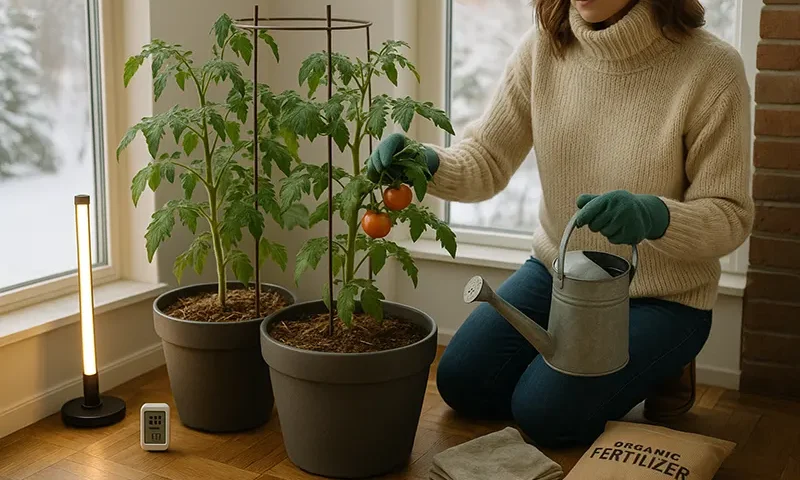
There is little that can rival the flavor of a vine-ripened tomato, but enjoying that taste when snow is falling outside seems like a gardening fantasy. While challenging, successfully growing tomatoes indoors during the deep winter months is entirely possible. It requires more planning and technical intervention than a summer garden, but the reward—a steady supply of fresh tomatoes—is well worth the effort.
The success of your indoor winter tomato operation rests on three critical pillars: selecting the right plant, compensating for minimal sunlight with powerful lights, and ensuring manual pollination.
I. Choose the Right Tomato and Container
You cannot simply bring your full-sized outdoor tomato plant inside and expect it to fruit. The first step to indoor success is choosing a variety suited for container life and limited space.
Tip 1: The Dwarf Difference. Opt for Dwarf or Micro-Dwarf Determinate varieties. Determinate tomatoes stop growing at a manageable height (usually 1 to 3 feet) and produce their fruit within a short window, making them ideal for indoor growing. Varieties like ‘Tiny Tim,’ ‘Micro Tom,’ ‘Red Robin,’ and various ‘Patio’ types are bred to thrive in pots without needing extensive staking or pruning, keeping your operation compact and manageable.
Container Choice: Tomatoes are hungry, thirsty plants. Even the dwarf varieties need space for root development. Select containers that are a minimum of 3 to 5 gallons (12 to 20 liters) per plant. Good drainage is non-negotiable; your pot must have holes at the bottom to prevent waterlogging and root rot. Fill your containers with a high-quality, well-draining organic potting mix, which will provide necessary aeration and structure for the roots.
II. Simulating Summer: Light and Temperature
The number one limiting factor for indoor winter tomatoes is light. The short days and low intensity of natural winter sunlight are insufficient for the heavy energy demands of a fruiting tomato plant.
Tip 2: Mandatory Grow Lights. For successful winter fruiting, supplemental light is mandatory. Invest in a Full-Spectrum LED Grow Light designed to mimic the sun’s energy. Standard incandescent or fluorescent bulbs will not work. A good rule of thumb is to aim for a minimum of 32 watts of actual LED power per plant, suspended close enough (usually 6–12 inches) to the plant tops.
You must keep these lights on for 14 to 16 hours per day to simulate summer conditions. Using an automatic timer is essential for consistency. Place your plants in the warmest, sunniest window you have, but rely on the grow lights, not the natural light, for their primary energy source.
Temperature Control: Tomatoes are sensitive to cold. To set fruit, they require consistent temperatures. Maintain a daytime environment above $65^{\circ}\text{F}$ ($18^{\circ}\text{C}$) and ensure nighttime temperatures do not drop below $55^{\circ}\text{F}$ ($13^{\circ}\text{C}$). Keep the containers away from drafty doors or cold windows to prevent temperature stress, which can cause blossom drop.
III. The Indoor Care Routine
Once light and temperature are stabilized, your focus must shift to care, specifically two aspects that the indoor environment completely disrupts: pollination and moisture.
Tip 3: Hand-Pollination is Key. In the summer, bees, wind, and insects shake the tomato flowers, transferring pollen. Indoors, you must act as the pollinator. When the small yellow flowers fully open, they are ready. Manually pollinate daily. The easiest methods are to gently tap the main stem or flower cluster with a finger, or to briefly touch an electric toothbrush to the stem just behind the flower. The vibration releases the pollen, ensuring fertilization. Perform this during the “daytime” when the grow lights are on.
Watering and Feeding: Overwatering is the biggest killer of indoor plants. Water deeply, but only when the top 1 to 2 inches of soil are dry to the touch. This helps prevent fungal issues and fungus gnats, a common indoor pest. Once the plant begins to flower, it needs a steady supply of nutrients. Use a balanced liquid fertilizer, shifting to one slightly lower in nitrogen and higher in potassium and phosphorus, which encourages fruiting rather than excessive leafy growth. Start feeding at half the recommended strength to avoid nutrient burn.
IV. Soil, Support, and Troubleshooting
Even with dwarf varieties, the weight of the fruit can cause the stems to bend or break, especially under the controlled humidity of an indoor environment.
Tip 4: Use the Best Soil and Support. Although dwarf varieties are compact, they benefit from a simple, sturdy stake or a small wire cage inserted into the pot to support the fruit-laden branches. For soil, using a new, sterile potting mix at the start of the season is your best defense against soil-borne diseases and pests.
Troubleshooting Common Issues:
- Legginess: Stems are thin and stretching excessively. Solution: The plant needs more light; move the grow light closer or increase its duration.
- Blossom Drop: Flowers dry up and fall off before setting fruit. Solution: Usually caused by inconsistent temperature, low humidity, or lack of pollination. Increase hand-pollination efforts and ensure consistent warmth.
By meticulously controlling light, temperature, and pollination, you can successfully bypass the limitations of winter. Investing in the right tools and tending to the specific needs of your chosen dwarf variety will ensure you are harvesting sweet, sun-ripened tomatoes while the ground outside remains frozen solid.
Do you have a specific dwarf tomato variety you’d like to research for indoor growing?

