
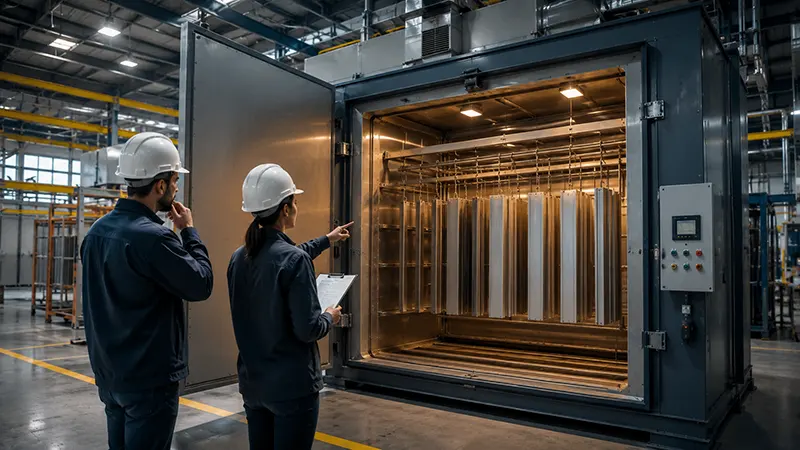
A finishing line often feels efficient until the oven starts holding everything back. Larger parts, heavier loads, denser racks, and shorter turnaround times can quickly reveal whether the curing setup has enough room, heat recovery, and airflow to keep pace. Reviewing oven capacity before investing in powder coating equipment helps shops choose a system that supports real production needs instead of creating bottlenecks after installation.
Dimensions and Interior Capacity
Oven capacity starts with usable interior space, not just the outside footprint. Parts need room for racks, hooks, carts, airflow clearance, and safe loading movement. A chamber that barely fits the largest part may still perform poorly if heated air cannot move around edges, corners, and recessed areas. Accurate sizing also helps shops plan for future work. A business may currently coat small brackets or panels, then later accept gates, frames, railings, machinery guards, or large assemblies. Buyers comparing Reliant powder curing ovens should review interior height, width, depth, door opening, and cart path before choosing a model.
Temperature Range and Uniformity
Curing depends on the metal reaching the powder manufacturer’s required temperature for the correct amount of time. Air temperature alone does not tell the full story because heavy steel heats slower than thin aluminum. A well-sized oven must deliver enough heat to bring real production parts up to cure temperature without guesswork.
Uniformity matters just as much as peak temperature. Hot spots can discolor powder or affect gloss, while cooler areas may leave coating under-cured. Reliant powder coating equipment should be evaluated for how evenly the oven maintains heat across the full chamber during loaded cycles.
Heating Source (Gas vs. Electric)
Gas and electric ovens each offer advantages depending on shop needs, utility access, operating cost, and production volume. Gas ovens often suit larger industrial workloads because they can provide strong heat recovery after loading heavy parts. Electric ovens may fit smaller operations or facilities where gas service is unavailable or impractical.
Utility planning should happen before purchase. Fuel availability, electrical capacity, installation costs, ventilation needs, and local codes can all affect the final decision. Shops reviewing Reliant powder coating equipment for sale should compare heating source options against both current use and expected workload growth.
Airflow and Recirculation Design
Airflow determines how effectively heat reaches every part in the oven. Strong recirculation helps move heated air around racks, through gaps, and across surfaces that might otherwise heat unevenly. Poor airflow can create inconsistent finishes even if the burner or heating elements are strong enough.
Loaded racks change the way air behaves. Dense batches, large panels, or bulky frames can block circulation and create cold zones. A properly designed powder curing oven should account for real loading patterns, not only empty-chamber performance.
Insulation Quality and Wall Thickness
Insulation helps the oven hold heat once it reaches the set temperature. Weak insulation can make the system cycle harder, waste energy, and struggle during repeated loading. Wall thickness, panel construction, seams, and door seals all influence temperature stability.
Durable wall construction also improves the working environment around the oven. Excess heat loss can make nearby areas uncomfortable and may affect other equipment or staging zones. Better insulation supports steadier curing, lower energy waste, and more predictable daily operation.
Control System and Timer Features
Controls help operators manage cure cycles with better repeatability. Timers, temperature displays, alarms, recipe settings, and digital controls can reduce mistakes when a shop runs different powders or part types. Simple, clear controls are especially helpful when several workers operate the same equipment across shifts.
Training should match the control system. Advanced features only help when the team understands how to use them correctly. Reliant powder coating equipment can give shops practical control options that support consistent curing without making everyday operation harder than necessary.
Exhaust and Ventilation Requirements
Exhaust systems help remove vapors, byproducts, and heated air as required for safe oven operation. Ventilation must match oven size, burner type, coating material, and local requirements. An undersized exhaust system can create safety concerns, while excessive exhaust may waste heat and raise operating costs. Facility layout also affects ventilation planning. Roof penetrations, duct routing, makeup air, and code requirements may influence where the oven can be installed. Capacity review should include how the oven will breathe inside the building, not just how many parts it can hold.
Safety Certifications and Compliance
Safety compliance should be part of the buying decision from the beginning. Industrial ovens may need to meet specific standards, inspection requirements, insurance expectations, and local code rules before operation. Documentation can affect installation approval and long-term facility planning.
Reliant Finishing Systems gives shops a product line that includes Reliant powder curing ovens and related powder coating equipment built for different production sizes, part types, and operating needs. Their oven options help buyers compare capacity, heat performance, airflow, controls, ventilation, and compliance details before investing in a system that fits real shop demands.

